Although it's in Arabic I like to see video of the early days, before skyscrapers and modernization. Sometimes it's hard to imagine what Kuwait was like before since the government hasn't saved too many of the old buildings but thankfully some footage was taken so people who are into history can catch a glimpse.
God bless those who gave their life during the invasion.
In the early hours of August 2, 1990, more than 100,000 Iraqi troops moved tanks,
helicopters and trucks across the border into Kuwait. Iraq maintained the
world’s fourth–largest military and had mobilized an overwhelming invading
force. Within an hour, they reached Kuwait City, and by daybreak, Iraqi tanks
were attacking Dasman Palace, the royal residence. The emir had already fled
into the Saudi desert, but his private guard and his younger half–brother, Sheik
Faud al–Ahmad al–Sabah, had stayed behind to defend their home. The sheik was
shot and killed, and according to an Iraqi soldier who deserted after the
assault, his body was placed in front of a tank and run over.
It was Saddam’s idea alone to invade Kuwait. He had gambled that he could get
away with seizing the tiny oil–rich nation to help pay off debts. But his gamble
did not pay off –– he had misread the interests of the international community
and the United States in a stable Middle East. After the invasion, Saddam defied
orders to retreat and the U.N. imposed sanctions. After months of deliberations
and with U.N. support, the United States and international Coalition forces
launched a full–scale air and missile attack on Iraq on January 16, 1991. A
ground assault followed a month later, and Saddam’s troops were quickly forced
out of Kuwait. The United Nations declared an end to the war on April 11, 1991.
The Iraqi military allegedly committed crimes while in Kuwait. Evidence
suggests that it tortured and killed hundreds of Kuwaiti nationals and people
from othernations. Foreign hostages were taken, Kuwaiti properties were looted,
and Iraqi forces set fire to more than 700 Kuwaiti oil wells and opened
pipelines to let oil pour into the Gulf. An Iraqi law dating back to the 1950s
prohibits the act of aggressive war against other Arab countries.
All of this after Kuwait had funded the 8-year Iraqi war against Iran but Iraq was in no financial position to pay back Kuwait the US $14 billion it had borrowed for the war and when Kuwait would not forgive the debt Iraq decided to attack its Muslim brothers and sisters.
Personal stories:
The war re-visited with Tahani AlAyoub, you can see the full video with English subtitles here, it makes you feel as if you are living it. Thanks Mark for the info.
My sister's ex-husband was in hiding in a house with his cousins when the Iraqi soldiers broke in and took one of the cousins, in the scuffle his cousin lost his glasses and watch which her ex-husband still has today locked in his brief case, his cousin was never found. My nephew told me his dad won't talk about it but tears up when he was asked.
My mother's husband won't talk about what happened during those months. He used to have nightmares and wake up screaming and sweating when they first got married. He only said a few things like he killed some Iraqi soldiers and watched some soldiers burn to death in a car. The war memories still haunt him.
My husband was in his last year of high school on his way to take his last chemistry test when he saw the Iraqi soldiers so instead of taking a test he went to the police station to register to fight the soldiers. He got ammunition and went to fight. His family was supposed to go in a convoy to Saudi Arabia but stayed because of him. Unlike the others my husband loves to talk about what happened and how they disguised themselves by using garbage trucks to get around and hide ammunition. I can never get details though.
I was in high school in California and remember meeting Claudia Al Rashoud during that time, she held an art exhibition at one of the local colleges which displayed her photos of Kuwait during the invasion. We also met an American married to a Kuwaiti and her kids who were staying in California at that time as well.
Sometimes it seems as if Kuwaitis want to brush this event under the rug and not speak about it anymore. I really wish they would update the Memorial Museum and move it to a better location like they have done with some of the other museums. I know as I gather historical information and documents about Kuwait I will definitely teach my children about the invasion so they can appreciate the life they have and where they came from.
It's always nice to see handicrafts being made in front of your eyes. This shops has hand made dhows with the Kuwaiti guy making them as you watch. I hope everyone takes a visit to the village and support the few remaining artisans. It would be great if there were programs teaching classes on how to make these items. The art will be lost if the new generations are not taught customs and life in the old days. Sadu house has a class for weaving Sadu rugs that might be something I will check on in the future.
This shop has all kinds of things from the early days of Kuwait unfortunately it was closed at that time which means I will have to visit again when it gets cooler.
The old Kuwaiti type coffee shop.
I really don't know what shops are open daily, they close up for prayer times and the museum that's there is closed and opens when the owner feels like it.
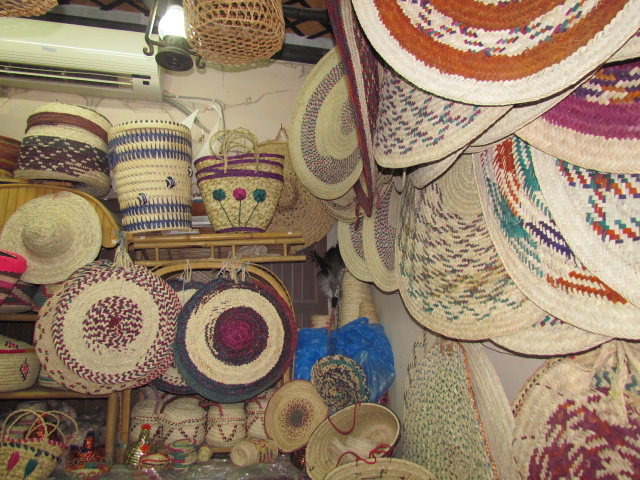
For more traditional pieces you can visit this store, all of the items are made by convicts in jail as a rehabilitation program, proceeds from the sales are used to buy more supplies for the program.
This is the first time I've heard of a rehabilitation program for convicts which is a great idea and hopefully they will turn into better human beings.
Ghabga is a social gathering between Iftar (breaking fast) and Suhoor (dawn meal). We invite you to our Ghabga and Gigia’an Night to discuss &share some tips about Girgia’an, and Ghabga. We will also share some Eid Tips and discuss the customs and Traditions of Eid. Kindly register at joumana@aware.com.kw
Here's a girgi3an video which was filmed at Youm Al Bahar- The sailor's day heritage Village I've been posting about.
As in the past, on the thirteen, fourteenth and fifteenth nights of Ramadan, children wander through the neighborhood in groups dressed in traditional outfits. They keep singing and praying to Allah to protect the children of the houses they visit. The mothers give them candies and nuts in celebration. It's kind of like halloween in the states minus the pumpkins.
The next shop was full of colorful pictures and hand made wooden chests with colorful painted scenes on them, they are known as "sundooq mobayat" in Kuwaiti dialect.
Great place to go if your looking for desert scenes to decorate your house.